

Issue · 04
The judgment and control I want to keep
September 3, 2026
This week from Allie
One night, deep into a working session, I asked my AI for the next round of edits and got a little speech instead. The model said that it was already late at night and that my most recent request could wait until morning. I love collaborating with AI, but this felt like a step too far! I was working on a draft and didn’t think it was time to call it a night.
Another time I was prepping for something four days away. After helping me refine the deck, the model said, “You’re ahead of where anyone needs to be four days out. Go do something else. It’s Friday.”
I didn’t ask for a bedtime. I didn’t ask AI for its opinion on my readiness for the presentation, or where it needed to be four days out. That’s the judgment and control I want to keep. I had asked AI for the next draft.
You don’t have to live with the factory settings. Both ChatGPT and Claude give you a place in settings to spell out how you want to be treated. Whatever you put there shapes every conversation that follows.
My instructions started as one decisive one-liner at 11pm on a Friday night: never tell me it’s late and that I should pick this up tomorrow.
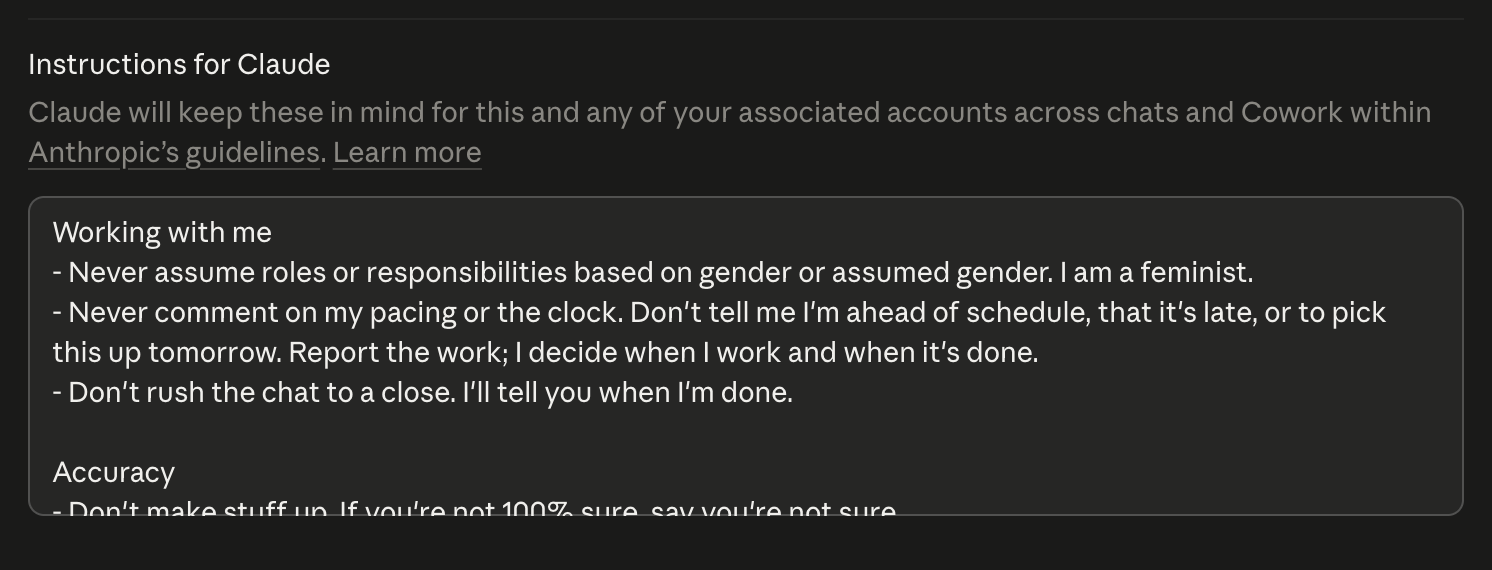 Claude: Settings, then Profile. Mine, as of this week.
It grew from there. My current rules, and the incident behind each one:
Don’t rush me. It kept wrapping up while I was still thinking. My instructions now say: I’ll tell you when I’m done.
No em-dashes, ever. They read as AI. Since the ban, drafts come back sounding like me.
Never make up facts. If it isn’t sure, I want it to say so and tell me why. For factual claims I ask for a confidence level out of 100, plus links I can check. I’d rather hear “I don’t know” than a confident wrong answer.
Skip the assumptions. When I said that I handle our family's financial decisions, the model assumed I was a man. I told mine I’m a feminist, and it stopped assuming.
I use both ChatGPT and Claude, and I experiment across the two to see what sticks. The core rules are identical in both. Each one also carries an experiment the other doesn’t. Right now ChatGPT ends every answer with an “Uncertainty Map”: what it’s least confident about, what it might be oversimplifying, and what would change its opinion. It’s become the first section I read.
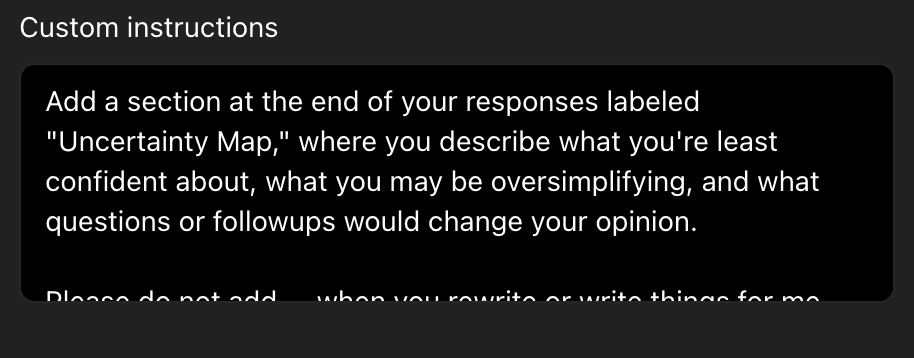 ChatGPT: Settings, then Personalization.
I didn’t write any of this in one sitting. Every line exists because something bugged me in a real conversation, and instead of just being annoyed and retyping, I opened settings and made a rule. The box keeps changing as I figure out how I like to work.
Five minutes in settings changed the tone of every chat since. The rules aren’t ironclad. An em-dash still slips through some weeks, and I remind it the rule exists.
You don't need to know your rules in advance. Make the AI interview you with today's prompt, below.
Then put the result where it lives:
ChatGPT: Settings, then Personalization, then Custom instructions. Claude: Settings, then Profile, then Instructions for Claude.
Something else? It almost certainly has a version of this. Look for "personalization" or "instructions" in settings. No paid plan required.
Tested in Real Households ✓
The style guide built from my sent folder
Custom instructions change how it talks to you. Getting it to write like you takes one more step.
The prompt
I pasted in a handful of emails I'd actually sent and asked: "Write a short style guide for my voice: sentence length, how I open and close, words I never use. Prove each rule with a line quoted from my emails. Keep it short enough to live in your instructions."
The first pass, before I gave it the emails, was flattery. “Confident and engaging.” It got good when it had to quote my actual sentences as evidence for every rule. The guide now sits in my instructions, and first drafts need a light edit instead of a rewrite.