

Issue · 05
What the first week back exposed
September 10, 2026
This week from Catey
At my younger daughter's Meet Your Teachers day, I realized there was a first-day form and a list of things to bring that I had never seen.
I assumed I'd missed the email. We had just moved, two kids were starting new schools, and I was also contending with things like a 63-page ballet handbook. I searched. Nothing. I asked again and was told it had definitely been sent.
Eventually, her teachers forwarded me the original note from June.
We had never been on the distribution list.
By then, she had arrived with a fairly dinky little comfort blanket while the other kids seemed to have elaborate rest-mat setups and bike helmets waiting at school. She was fine.
It was a useful reminder that some parts of September are going to be messy no matter how organized you are.
The first few weeks back are also very good at exposing the places where your routines are making things harder than they need to be.
We're adjusting to a driving commute after years in New York. I had accounted for the drive. I hadn't accounted for how long it takes to get two small children out of the house and physically strapped into two car seats.
So we're changing things as we go. We moved when we feed the dog. We got a second set of toothbrushes for downstairs. We're waking the kids up 15 minutes earlier, and we're dressed and ready to walk out the door before we do it. I'm waking up earlier too, because an hour alone before everyone else gets up makes a meaningful difference. We're still contemplating whether breakfast occasionally belongs in the car.
None of that took much figuring out. I could watch where the time was going.
The ballet handbook was harder.
Figure out the problem first
The handbook lives in Canva. I wanted a PDF I could feed to AI to generate a short version of what I actually needed to know as a parent.
ChatGPT couldn't get through the Canva setup. Claude couldn't either. Both offered reasonable alternatives: ask the studio for a PDF, or work from what's on the studio website. Neither was what I wanted.
So I tried Instinct, a new AI personal assistant that can operate a browser and computer.
It could read the handbook. Canva had downloads locked, so it couldn't export the file, but instead of stopping there it rebuilt all 63 pages into a PDF for me. Fully legible, though not text-searchable. It took about an hour. At one point it texted to warn me it was at compute capacity and running slowly.
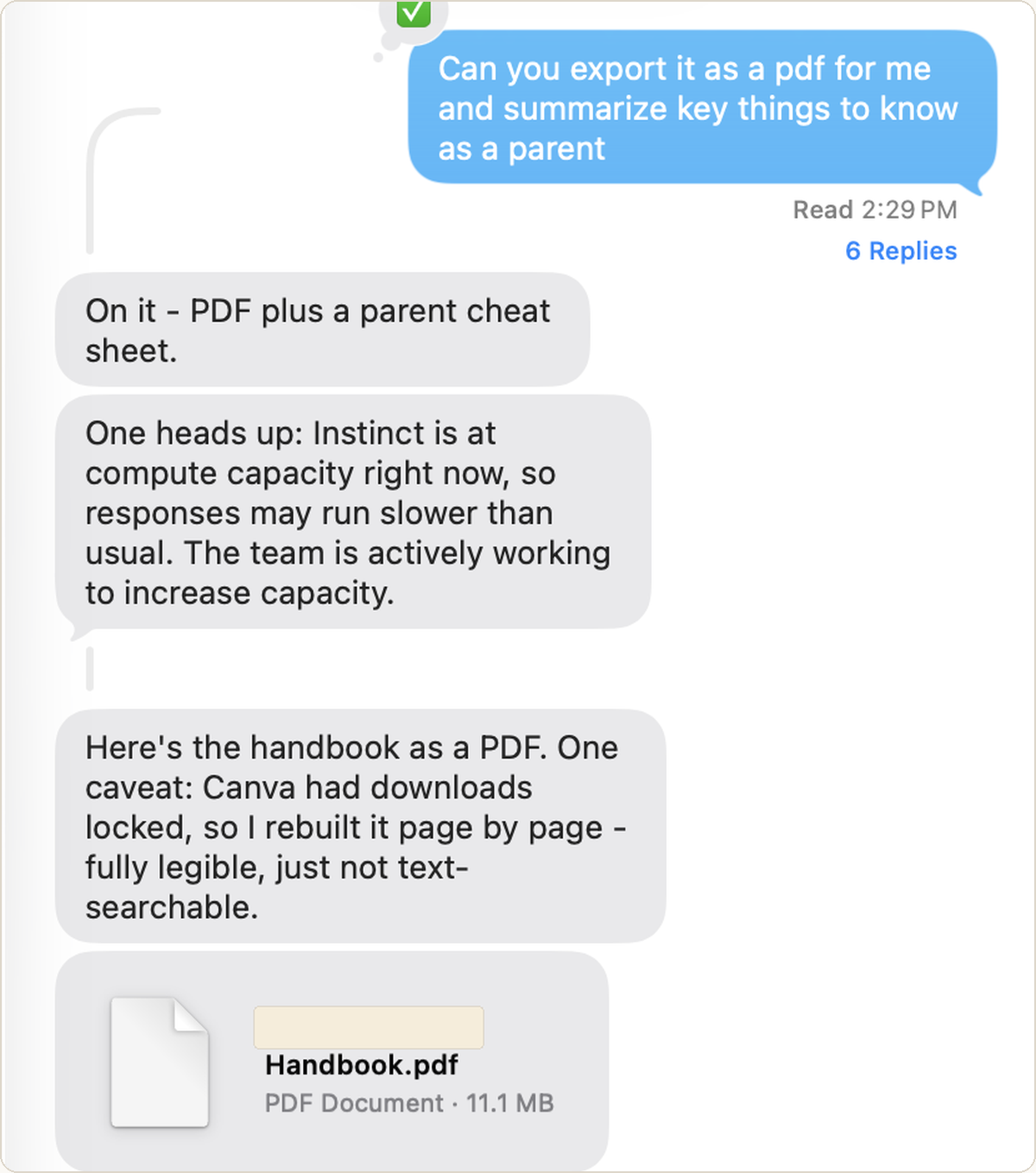 It rebuilt all 63 pages by hand, and told me it was running slowly while it did.
It also sent a parent cheat sheet, which was a fine generic summary. The version I actually wanted was specific to us, and getting that meant telling it which kids, which classes, which schedule. That is a fair amount of information about my children to hand to a tool I had been using for an hour and had not read the privacy policy for. So I took the PDF it made, brought it back into Claude, and asked there instead.
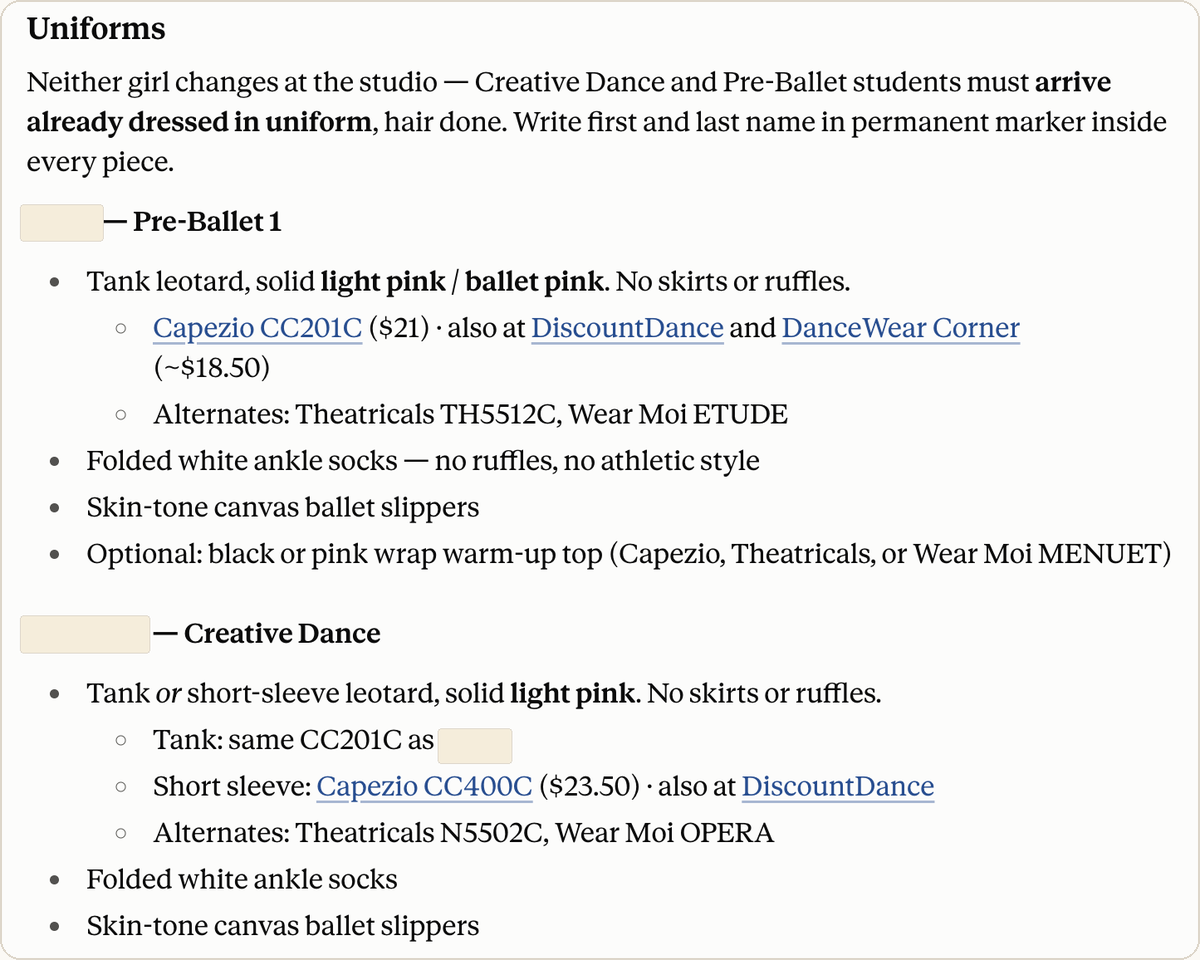 Two kids, two different classes, one list of what each of them actually needs.
A lot less seamless than "upload handbook, receive answer." But it clarified something useful well beyond this particular ballet school.
My first problem wasn't that I had 63 pages to read. It was that I had a document I couldn't get into a usable format. Instinct happened to be good at that part. Once I had the file, pulling out what applied to us was an easier job for a tool I already use and was more comfortable giving context to.
Compare that with our mornings. I don't need to ask an AI why we're leaving late when I can watch us spend too long getting into the car. We needed to get up earlier and be ready before the kids were.
Or the missing school form. I searched plenty. There was simply no email to find.
September throws a lot at you at once. Before deciding you need a new app, a new routine, an automation, or an AI solution, get specific about what's actually going wrong. If you're late, where did the time go? If you keep forgetting something, when does the handoff break down? And a task that's eating headspace usually has one part that's the genuinely hard part. It's worth knowing which.
Sometimes, once you can name that part, the fix is obvious. Sometimes AI is very good at it. Sometimes the answer is a second set of toothbrushes.
Today's prompt
Don't open an AI tool yet.
Grab a pen and paper and leave it somewhere visible for the next few days. Each time a recurring part of family life feels harder than it should, jot down what actually happened.
Not "mornings are a mess." Try:
- We left ten minutes late because getting everyone into the car took longer than I planned.
- I went back upstairs twice for things we use every morning.
- I had to remind everyone about the same thing again.
- I spent 20 minutes hunting for information I thought I already had.
- I had a 63-page document when I really needed five things from it.
After a few days, look at the list and get specific about where the friction is.
Then choose the solution. Maybe it's moving something, changing the timing, adding a reminder, asking another person for help, or giving one clearly defined part of the job to AI.
Try this week
Make Gemini dig through your Gmail archive
Gemini can search your Gmail including attachments, which turns out to be very good at deep cuts. The most recent vaccination records. A passport scan from three years ago. The current version of a PDF someone sent you twice.
Things that used to cost me ten or fifteen minutes of scrolling through search results came back almost immediately. Worth knowing: if you pay for Google storage, you probably already have the paid Gemini tier and don't realize it.