
Issue · 09
When a one-off task becomes a system
October 8, 2026
This week from Catey
A few weeks ago, my husband forwarded me an email with the subject line “Cubs Class Room Helpers.”
His commentary: “Um, not sure I showed interest for this properly 😬”
Apparently, somewhere along the way, he had accidentally volunteered to be a room helper for our three-year-old’s class. I took one for the team and assumed his duties.
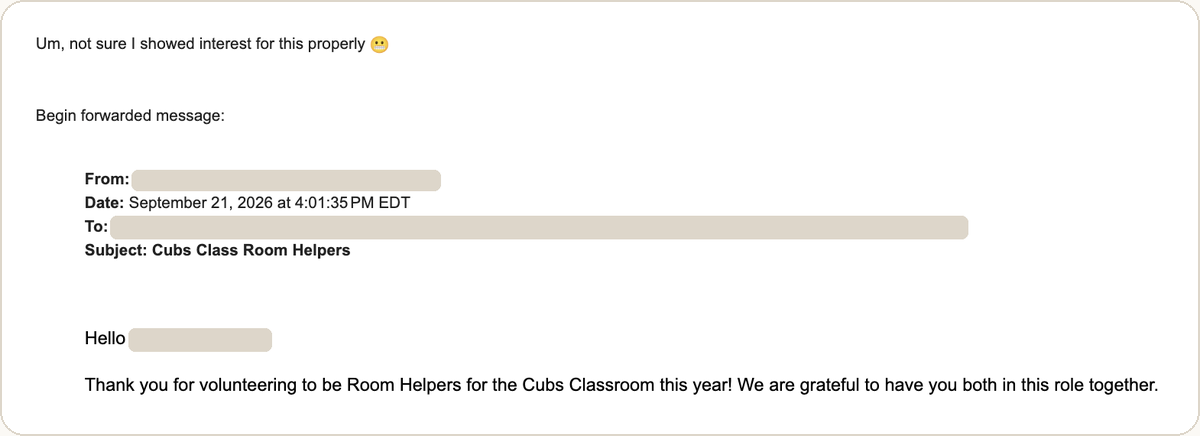 The email in question.
The job itself isn’t onerous. But it is exactly the kind of thing that adds to the mental load: a long monthly email with dates and instructions, a separate document with suggested messages, a school calendar to cross-reference, and a handful of WhatsApp reminders that I am personally responsible for remembering to send at the right time.
This felt like a perfect job for AI.
I set up a Project in Claude (a dedicated workspace that holds the documents and instructions for one ongoing thing) for my new career as a room helper, added the relevant school materials, and forwarded in the monthly email.
First, I asked Claude to figure out what actually applied to our class and what I needed to do. It pulled out my action items, important dates, and the WhatsApp reminders I was responsible for sending.
Then we made it useful.
I asked it to map those reminders onto my calendar a day or two before each event, with a ready-to-send WhatsApp message in each calendar entry. A few reminders landed on back-to-back days, so I asked it to consolidate them. I didn’t like the emojis in the drafts, so we took those out too.
At that point, October was handled.
But the most useful part was what I did next: I asked Claude to write down the process we had just created.
Now the Project knows which events apply to our class, which documents to cross-reference, how far in advance I want reminders, when to consolidate them, how I want the messages written, and what it should show me for approval before anything goes onto my calendar.
Next month, I can drop in the November email and have it run the same process.
That’s the bigger idea here: you don’t have to design the perfect AI workflow before you start. Do the task together once. Correct and refine the output as you go. Then ask AI to capture what it learned so you don’t have to start from scratch next time.
Try this week
Do it once. Then make it repeatable.
Think of one annoying thing you do over and over: processing a school email, planning meals, preparing instructions for a babysitter, packing for a weekend away, organizing birthday gifts, or anything else that has you remembering the same steps every time.
Use ChatGPT or Claude to help you do it this time. Then, in that same chat, when you’re finished, try:
Based on everything we just did, including the changes and corrections I made, write instructions you can follow the next time I need to do this. Ask me about anything that isn't clear enough to turn into a rule.
Save those instructions somewhere AI can reference them again. A Project can be especially useful when the task also relies on the same documents or background information each time.